Technology and UDL

Designing for Inclusion
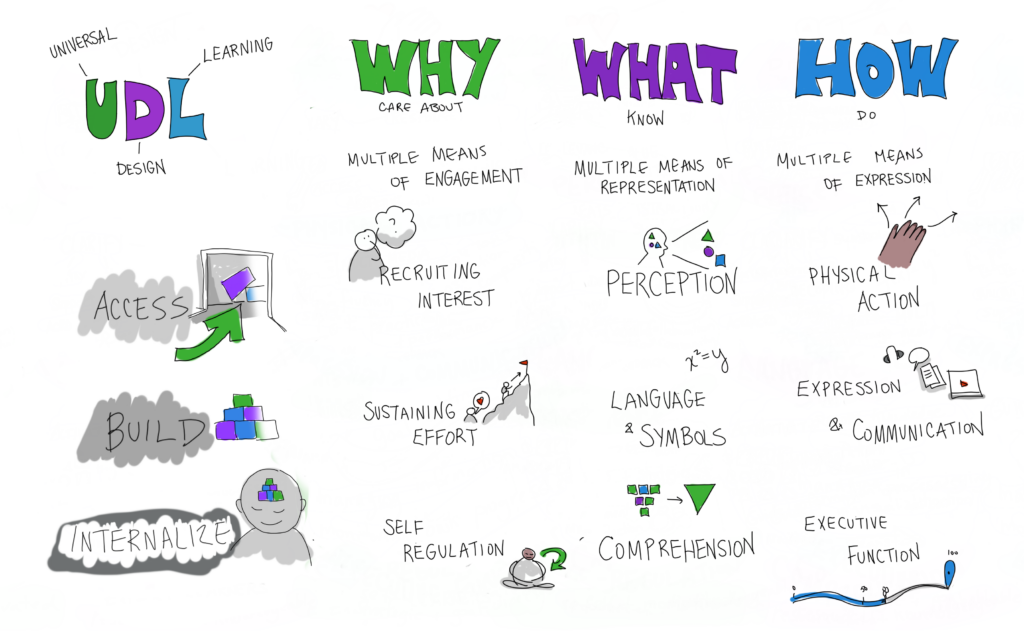
From: Inclusion, Diversity, Equity and Accessibility. The Why, What and How of Universal Design Learning.

The learning resource will be hosted on WordPress, which functions as a central home page for the learning modules. The site will include a short introduction and clickable modules aligned with the climate change topics, allowing students to move through the content at their own pace. Each module integrates text, images, videos, and simple interactive activities such as quizzes and matching tasks.

This design supports Universal Design for Learning (UDL) by providing multiple ways for learners to access and interact with the material. As shown in the UDL framework above, learning design can support three key areas: engagement (why learners care), representation (what they learn), and action and expression (how they demonstrate learning). In the WordPress modules, engagement is supported through interactive videos, games, and real-world climate action examples that help spark interest. Representation is addressed through a mix of text, images, diagrams, and videos that explain climate change concepts in different formats. Finally, action and expression are supported through activities such as quizzes, matching exercises, and even short reflections to think about, which allow learners to demonstrate their understanding in different ways.

Technology Choices

The resources we have curated cater towards a younger audience, such as with short form videos and interactive websites.

These online based resources will show how human activities warm the planet and answer common questions as well as dispel misconceptions about climate change.

Learners will be directed towards action‑focused hubs such as CleanBC’s “Actions you can take” page and the United Nations “ActNow” site give learners concrete ideas for what they can do at home, at school, and in their neighborhoods, helping them connect the science of climate change with hopeful, real‑world solutions while having fun.

To access the different modules, learners will need a device with a web browser, such as a computer, tablet, or smartphone, that can load the WordPress site, play embedded YouTube or similar videos, and display images and interactive quizzes. Videos will include transcripts to support accessibility. Depending on the learning environment, headphones may also be helpful if students are working through video modules at different speeds in a shared space.

Across the modules, learners will use the WordPress site to read text, view diagrams, and complete interactive activities. These activities may include drag-and-drop tasks, form-based sorting activities, matching exercises, and short quizzes designed to reinforce understanding.


Design choices

Learning Theory

Our design choices are mainly based on constructivism, with some support from cognitivism.

Constructivism is a strong fit for this climate change resource because students actively build understanding by exploring the content rather than simply memorizing information.

As learners move through the WordPress site, they navigate between different posts and pages that introduce topics such as greenhouse gases, causes of climate change, environmental impacts, and how to reduce it.

This structure allows learners to interact with the material by watching videos, viewing images, completing short quizzes and or matching words, that help them reflect on what they have learned. These interactive elements encourage learners to construct meaning through engagement with the content (Ertmer & Newby, 2013).

Cognitivist ideas also influence the design because climate change can be a complex topic for younger learners.

The resource breaks information into smaller sections and supports learning with visuals, videos, and simple explanations that help students organize new information and connect it to what they already know (Ertmer & Newby, 2013). Short quizzes and activities throughout the modules also provide feedback that helps learners check their understanding and reinforce key concepts.

This design works well for the topic of climate change because the subject can be complex and easier to understand when information is broken into smaller sections. Videos and images help explain ideas in a clearer and more engaging way.

The quizzes encourage learners to actively think about the content rather than just read it. Allowing students to move between pages also helps them explore the topic at their own pace and focus on the areas they find most interesting or challenging.

Learning Design

The learning design used in this resource follows an inquiry-based approach. This means students are encouraged to ask questions, explore ideas, and build their own understanding instead of just being told information.

This works especially well for climate change because it helps learners think about a real-world problem and understand how people’s actions can affect the Earth.

In this module, students learn by exploring short videos, pictures, and simple explanations about greenhouse gases, the causes of climate change, and its effects on the planet. As they move through the pages, they interact with the content by completing quizzes, looking at images, and watching videos. This makes learning more active and helps students connect ideas across the module.

Inquiry-based learning is a good fit here because climate change is not just something students should memorize. It is something they need to think about, question, and connect to everyday life. The interactive activities help students use what they are learning instead of just reading or watching passively (Burns, 2020). The design also includes different ways for students to interact, such as engaging with videos and quizzes and, when appropriate, sharing ideas with classmates through discussion activities. These kinds of interactions can support deeper learning in online environments (Anderson, 2003; Moore, 1989).

Overall, this design is effective because it makes a big and sometimes difficult topic feel more interesting, interactive, and meaningful for learners.

references

Anderson, T. (2003). Getting the mix right again: An updated and theoretical rationale for interaction. International Review of Research in Open and Distributed Learning, 4(2), 1–14. https://doi.org/10.19173/irrodl.v4i2.149

Burns, M. (2020). Inquiry-based learning: A review of the research literature. Global Partnership for Education.

Moore, M. G. (1989). Three types of interaction. American Journal of Distance Education, 3(2), 1–7. https://doi.org/10.1080/08923648909526659

Ertmer, P. A., & Newby, T. J. (2013). Behaviorism, cognitivism, constructivism: Comparing critical features from an instructional design perspective. In R. A. Reiser & J. V. Dempsey (Eds.), Trends and issues in instructional design and technology (3rd ed., pp. 50–61). Pearson.

image 1:R.b1b78d1e4b945173b4743e53775f5aef (300×341)

Image 2: friendly-clipart-kindness-child-1.png (1400×930)

image 3: https://img.freepik.com/premium-vector/realistic-clipart-square-artboard-illustrator_909708-8853.jpg?w=740

Definition and Description

Definition

We wish to create our interactive learning resource about climate change to get youth to think about its causes and effects in such a way that they are concerned yet hopeful about the issue. First we will focus on what climate change means, that is, an overall average in global temperatures caused by greenhouse gases like carbon dioxide, methane, and water vapour trapping energy in our atmosphere (Jadhav, Raut & Mondal, 2025). Next we will explore the natural and human causes of these greenhouse gases; causes we will elaborate on will include transportation, agriculture, land-use change, and any others that may fit into our objectives as we develop our resource. We believe following this up with climate change impacts on plants, animals, and weather will provide excellent real-world and tangible examples to complement the introductory lesson. These categories are amongst the most impacted by climate change and carry a lot of unpredictability (Stephen & Duncan, 2023). We will then highlight some positives that are coming out of climate initiatives, particularly community resilience and improved relationships with nature (Butt, 2025 & Calheiros & Vasconcelos, 2022).

Learning Context/Audience

Description of your learning context and learners, e.g., educational background (high school students, post-secondary students, professionals) age, interests, lifestyle, prior knowledge and experience, and any specific learning needs-kr

It’s best to design the module with Universal Design for Learning (UDL) in mind, so it works for a wide range of learners by offering different ways to engage with the content, take in information, and show understanding.

For example, instead of long, dense pages, the lesson is broken into short, clear sections with quick, less stressful check-ins to help with focus and pacing (this is especially helpful for learners with ADHD or who struggle with executive functioning, Rao, 2019). Furthermore, the concepts can be supported with a simple glossary and strong visuals for English language learners, and every video or audio piece includes captions and transcripts for students with hearing loss. The pages can also be built to work well with screen readers and include text-to-images to support low vision or print disabilities, and we can avoid using colour as the only way to communicate meaning by using high contrast, labels, and clear formatting for colourblind learners (Rao, 2019). Finally, to keep access realistic, the module will be mobile-friendly and paper-friendly, and all will have options to download paper resources for students who don’t always have reliable internet or a computer.