First, to discuss climate change, we must explore what is causing it. The main drivers for climate change are what are known as “Greenhouse Gases” (GHG). These are gases that are present in the atmosphere that trap the heat from the sun in the Earth’s atmosphere1. Heat gets trapped through a process called the Greenhouse Effect.
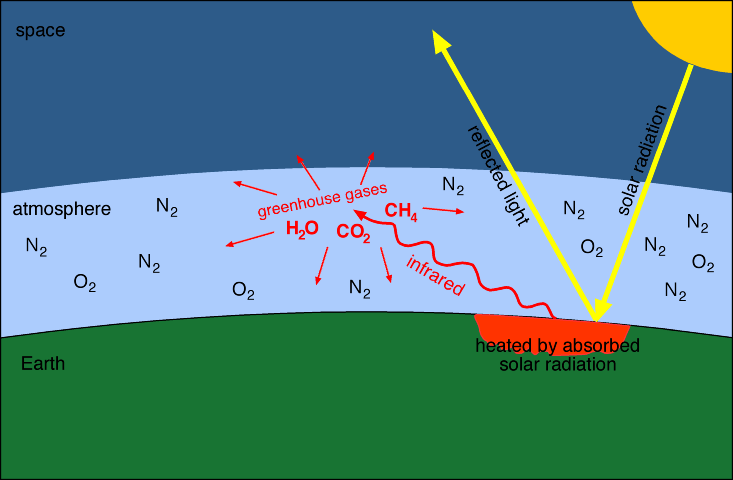
GHGs have always been in the atmosphere and are a crucial part of sustaining life on Earth. With the help of GHGs, the average temperature on Earth comes to about 15°C. Without these gases, the average temperature on Earth would drop to -18°C, and most of Earth would be frozen!
Important Greenhouse Gases
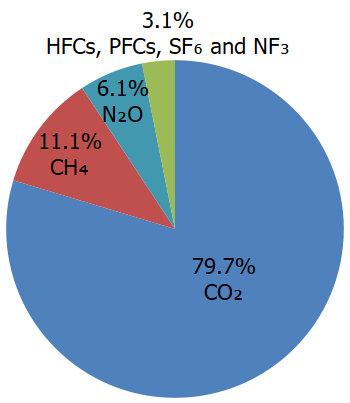
GHGs in our atmosphere mainly consist of Carbon Dioxide (CO₂), Methane (CH₄), and Nitrous Oxide (N₂O). As seen in figure 1, there are seven GHGs that are currently being tracked. The green part of the pie chart represents what is known as the Fluorinated Gases (or F-Gases, because they all contain at least one fluoride atom).
What do Greenhouse Gases look like?
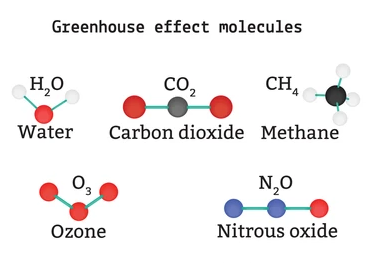
Greenhouse gases are structured simply and very stable, which is why they are a common byproduct of many processes humans do on Earth. 3 Below, in Figure 2, you can see the structure of some of the greenhouse gases we have already explored! In this diagram, the Oxygen atoms are red, Hydrogen atoms are white, Nitrogen atoms are blue, and Carbon atoms are black/grey.
Look through each molecule and see if you can find the ones we haven’t covered yet. Think about why these molecules may be on this list of ‘Greenhouse effect molecules.’
If you want to build greenhouse gases, click on the button below to visit an interactive site!
To explore Greenhouse Gases, watch this 3-minute video that breaks down the different gases that contribute to climate change:
View Transcript
0:00
Announcer: Have you heard the term “greenhouse gases?”
0:03
Let’s break it down.
0:04
First, let’s talk about greenhouses.
0:07
You know those glass buildings that are used to grow plants?
Greenhouse gases explained
0:11
Those glass walls trap the sun’s heat so plants can
0:14
stay warm even in the winter.
0:17
That’s pretty much what greenhouse gases do for Earth.
0:21
They’re actually a natural part
0:22
of the Earth’s atmosphere.
0:25
Think of greenhouse gases like a blanket,
0:27
they wrap around our planet, keeping it warm,
0:30
so that we can live on it.
0:31
Hmm.
0:32
But hear me out.
0:34
You’ve heard of Goldilocks, right?
0:35
It can’t be too hot or too cold,
0:38
the conditions have to be just right.
0:42
Because of human activities in the last century,
0:45
there are more greenhouse gases being
0:47
released into the atmosphere, disrupting the balance.
0:50
And that means more heat is getting trapped near
0:53
the Earth’s surface, causing temperatures to rise.
0:57
And yes, you guessed it, the unusual increase of
1:00
the Earth’s surface temperature is
1:02
called global warming.
Types of greenhouse gases
1:05
So, what exactly are the greenhouse gases
1:07
in the atmosphere anyway?
1:09
Well, let’s break down five main types.
1:12
First, carbon dioxide.
1:15
It’s the greenhouse gas with the biggest total
1:17
impact on climate change.
1:19
Most of the CO2 in the atmosphere has come
1:22
from burning fossil fuels,
1:24
so coal, gas and oil.
1:27
And then we have methane.
1:28
It’s released when fossil fuels
1:30
are extracted from the Earth,
1:32
it’s also released by livestock, like cows.
1:37
Next up is nitrous oxide.
1:39
This gas can be released during industrial
1:41
activities and from burning fossil fuels
1:44
or solid waste.
1:45
Then we’ve got fluorinated gases.
1:47
There are different kinds, but the ones you might be
1:50
most familiar with are in your fridge.
1:52
It’s used to keep things cool.
1:55
And finally, water vapour.
1:57
Okay, water vapour isn’t the main cause of global warming,
2:00
but it is an effect and contributor to it.
2:04
Oh.
2:04
Because of global warming
2:06
more water evaporates,
2:08
so more water goes into the atmosphere,
2:11
trapping even more heat
2:12
near the Earth’s surface, and the cycle continues.
2:16
Depending on the type, greenhouse gases can stay
2:19
in the atmosphere for a few years
2:21
or even for thousands of years.
Effects of greenhouse gases
2:24
You’re probably wondering,
2:26
“What are some of the effects of these greenhouse gases?”
2:29
Well, when the Earth’s temperature rises,
2:31
that can cause more frequent and intense heat waves,
2:34
droughts, and floods.
2:36
The extra CO2 is also changing the ocean’s chemistry,
2:39
effecting marine animals and making
2:41
it harder for them to survive.
2:43
But there are ways to prevent things from getting worse.
2:46
Head to cbckidsnews.ca for those details.
2:50
♪ ♪
Water Vapour
Water vapour is actually more abundant in the atmosphere than carbon dioxide! 4 Think of the water cycle, throughout this cycle, lots of water ends up in the atmosphere through evaporation. But did you know that the evaporated water in the atmosphere also acts as a Greenhouse Gas?
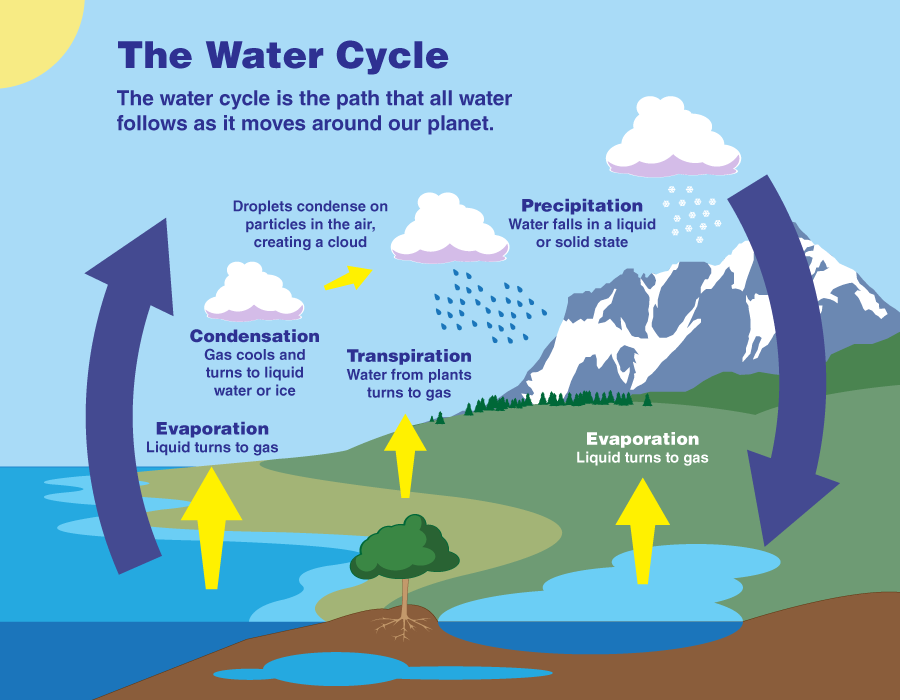
Even though water vapour is a Greenhouse Gas, it doesn’t actually cause temperatures to rise. Instead, water vapour is a byproduct of increases of other Greenhouse Gases! As levels of carbon dioxide, methane, nitrous oxide, and other GHGs increase, the temperature of the atmosphere increases as well. Because warmer air can actually carry more water vapour!
The way this process contributes to warming temperatures is because water vapour absorbs heat that is trying to escape back out to space. This heat then gets stuck in the atmosphere, warming the planet. Since this process ends up warming the Earth, it further increases how much water vapour the atmosphere can carry. This phenomenon is known as a “Positive Feedback Loop”
Ozone
While often associated with the “Ozone Hole” and protection from UV radiation, ozone plays a dual role in our atmosphere depending on where it is located. 5 In the context of climate change, it is important to understand how ozone acts as both a protector and a greenhouse gas.
Ozone is a gas composed of three oxygen atoms. Its impact on life and climate depends entirely on its altitude in the atmosphere:
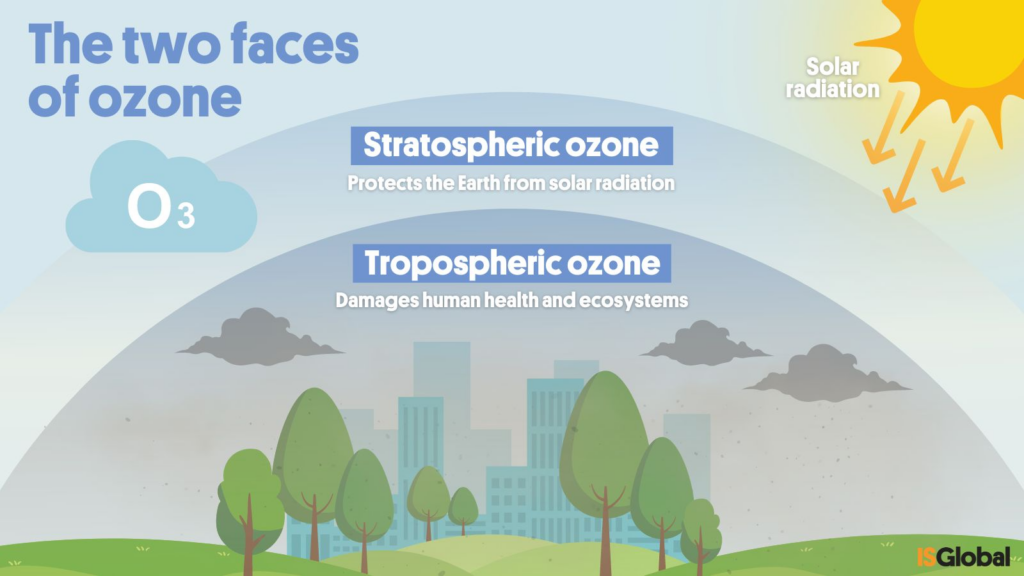
- Stratospheric Ozone (“Good” Ozone): Located about 15 to 30 kilometres above the Earth’s surface, this layer protects us from the sun’s harmful ultraviolet (UV) radiation. Without this layer, many ecosystems would collapse, and humans wouldn’t be protected from these rays.
- Tropospheric Ozone (“Bad” Ozone): Located in the lower atmosphere (where we breathe), this ozone is a human-made air pollutant. It is the primary component of “smog.”
While carbon dioxide and methane are the most discussed greenhouse gases, tropospheric ozone is the third most important greenhouse gas. Unlike carbon dioxide, which is emitted directly from cars and factories, tropospheric ozone is a secondary pollutant. It is formed when sunlight reacts with pollution from fossil fuel combustion. Once formed, it traps heat in the lower atmosphere, contributing to global warming.
True or False Activity:
References
- Center for Climate and Energy Solutions. (2025, September 16). Main Greenhouse Gases- Center for Climate and Energy Solutions. https://www.c2es.org/content/main-greenhouse-gases/ ↩︎
- US Environmental Protection Agency. (2025, December 29). Overview of greenhouse gases https://www.epa.gov/ghgemissions/overview-greenhouse-gases ↩︎
- Center for Climate and Energy Solutions. (2025, September 16). Main Greenhouse Gases- Center for Climate and Energy Solutions. https://www.c2es.org/content/main-greenhouse-gases/ ↩︎
- Cermak, A. (2024, October 23). Steamy Relationships: How Atmospheric Water Vapor Amplifies Earth’s Greenhouse Effect. NASA Science. https://science.nasa.gov/earth/climate-change/steamy-relationships-how-atmospheric-water-vapor-amplifies-earths-greenhouse-effect/ ↩︎
- Grylls, T. (2025, July 8). The forgotten greenhouse gas: tropospheric ozone. Clean Air Fund. https://www.cleanairfund.org/news-item/greenhouse-gas-tropospheric-ozone/ ↩︎